I used to wonder how much the architecture of Oxford and Cambridge affected the mindset of its longterm employees. Living and working amongst those buildings, massive, monumental representations of the institutions’ age, status and venerability… How much might this condition you to think a little more complacently of yourself (as the present-day representative of this heritage) and to think about the world a little more conservatively, than you would otherwise? Similarly, if you went to Eton, then Oxford, then worked in Lincolns Inn Fields, how might such an unbroken succession of film-set dreaming spires subconsciously condition you?

I don’t know how this effect could be tested for or quantified. And anecdotally at least I’ve not found it to be borne out by experience. (My friend and sample-group-of-one in Lincolns Inn volunteered for Obama and runs a Palestinian campaign group.) But I happened to be thinking about it a week ago, when I read this Sophie Heawood piece on The xx. Understandably enough, it picks up on the angle about their school: Elliott, a comprehensive in Putney previously attended by Burial, Fridge (two of whom release solo records as Adem and Fourtet) and two-fifths of Hot Chip. And some Maccabees. (Though arguably the most successful Elliott product is this shredder). I should admit that I know some Elliott alumni very well and can report that Heawood’s description is pretty accurate. They do have a somewhat cult-like insularity: they’re reluctant to associate with outsiders, they wear flowing white robes, and they gather every summer solstice on Putney Heath to worship a huge flaming effigy of a deity they name Victor. But while Elliott has been the subject of plenty of articles already, it's the first I‘ve seen mention it as a built environment. Heawood says the band were affected by ‘the sense of space in the school itself — which itself was “weirdly massive”, according to Sim.’

From images found online (all at elliottonian.com), it looks like a kind of soft brutalism to me: modernist, exposed stairwells and functions, but with glass winning out over concrete expanse or massive bulk. Not quite a 'council estate prison’ as The xx's Madley Croft has it (whatever that would be). No doubt Fantastic Journal, Entschwindet und Vergeht and Sit Down Man can make more of it, tell me what I‘m missing etc. I like the sheer horizontal persistence of the main building and the gym / theatre (?) looks interesting.


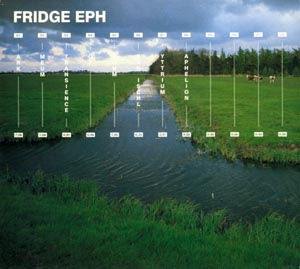
In relation to the Elliott discography I can’t see/hear anything as striking as the connection made in Militant Modernism between brutalist social housing and the sonic brutalism of grime. None of the Elliott discography could be described as brutalist, though there are jagged outbreaks in Kieran Hebden’s duo sets with Steve Reid, and some gloriously maximalist aggro in Hot Chip tracks like Shake a Fist. It’s wrong to generalize, but if I had to I would say there’s a kind of collective urban pastoralism at work. Check out these two Fridge covers; Hot Chip are as influenced by the low-key lushness of Hall & Oates, Robert Wyatt and Will Oldham’s Appalachian modes as they are by post-Timbaland electro-futurism; Adem’s records are post-Pro Tools kitchen table Cloth Cuts pillow talk. The xx are obviously in love with the lo-fi pastoral of Young Marble Giants (another Putney connection there, because Domino, whose offices are in Putney, reissued YMG in 2007, when The xx would have been 16/17). The master image of Burial’s first album was London, submerged under a broken-barriered Thames (…and the Wendle, one of London‘s underground rivers, flows nearby). So maybe, if you had to (idiotically) generalize, you could detect a kind of quiet polemic, a naturalization of city life. Because if there is a kind of 'fields beneath’, under-the-pavement-the-beach dynamic, it’s not about alienated hippie anti-urbanism, but a rejection of that rejection. Nor is it situationist denaturalization, a making strange of the concrete city, but instead buried in the background hum of the music, a straightforward celebration of it.